Geoff Was A Reader
Why do we fall in love?
Last year I developed a theory.
We fall in love because we are drawn to something only this person can teach us.
I am still learning from Geoff and I expect to keep learning from him for the rest of my days on this planet.
This is my second annual essay about what I'm learning from Geoff.
###
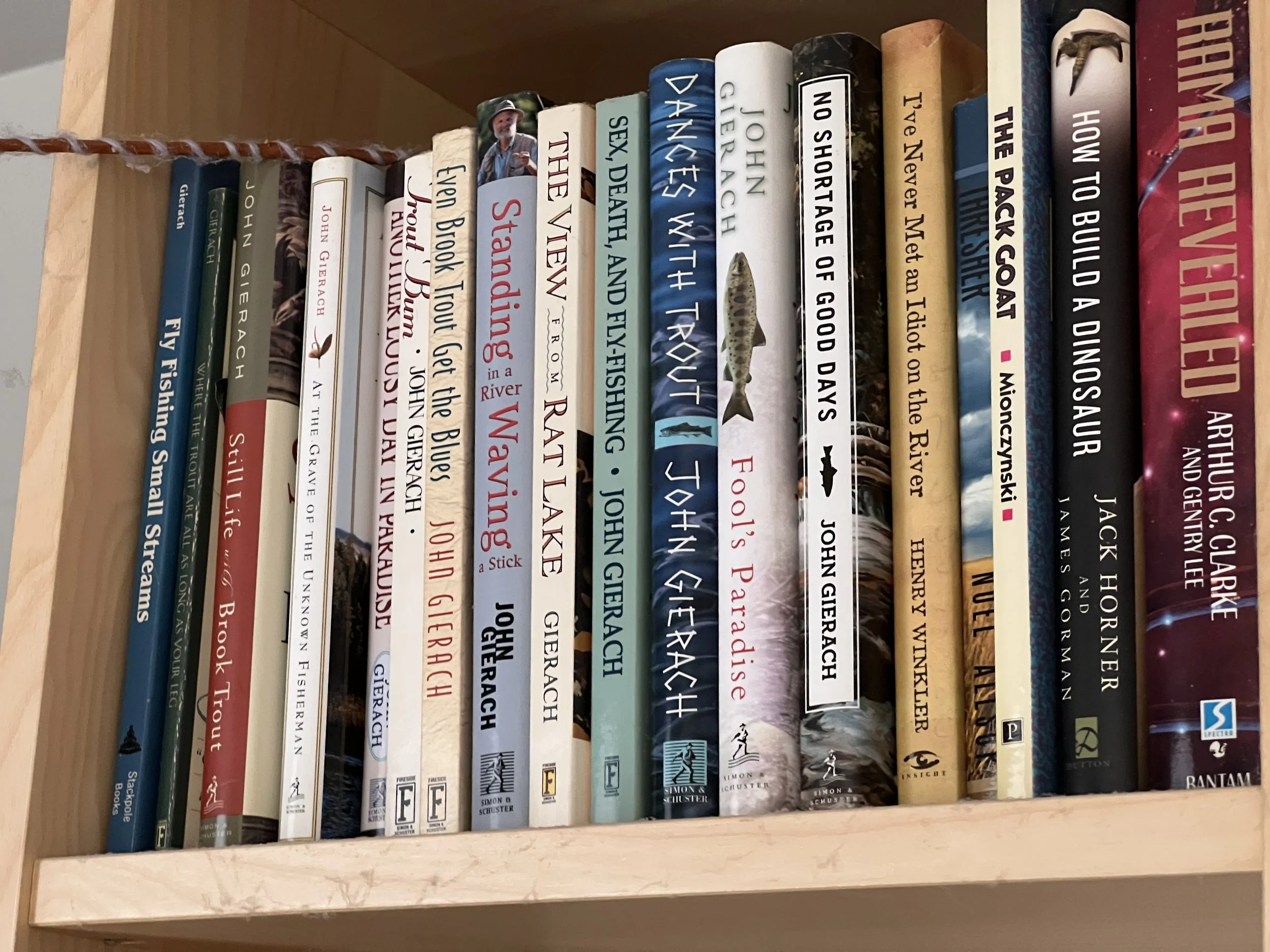
If you’re a librarian who returns books to shelves, you might see this group of books and think 799.1 (and the reshelve the four books on the right.) The stick with yarn wound around it is a toy fishing pole, with a magnet on the end for catching fish made from felt with internal magnets. Coincidence ( I think) that is was shelved with Geoff’s fishing books.
Geoff was a reader.
Is the spring of our junior year of high school, as we were going into final exams, I handed Geoff a paperback set of the Lord of the Rings. Geoff was so enraptured by Tolkien that he skipped studying and stayed up all night to finish reading and took his exams bleary eyed.
This was the beginning of a lifelong devotion to all things Tolkien.
He read The Lord of the Rings to me when I was pregnant with Ben. He read The Hobbit and the entire Lord of the Rings to little Ben before he started kindergarten. He read the epic to Nora and to grandkids. When he wasn't reading this story aloud, he generally reread it on his own every year, or in more recent years, listened to the Andy Serkis version.
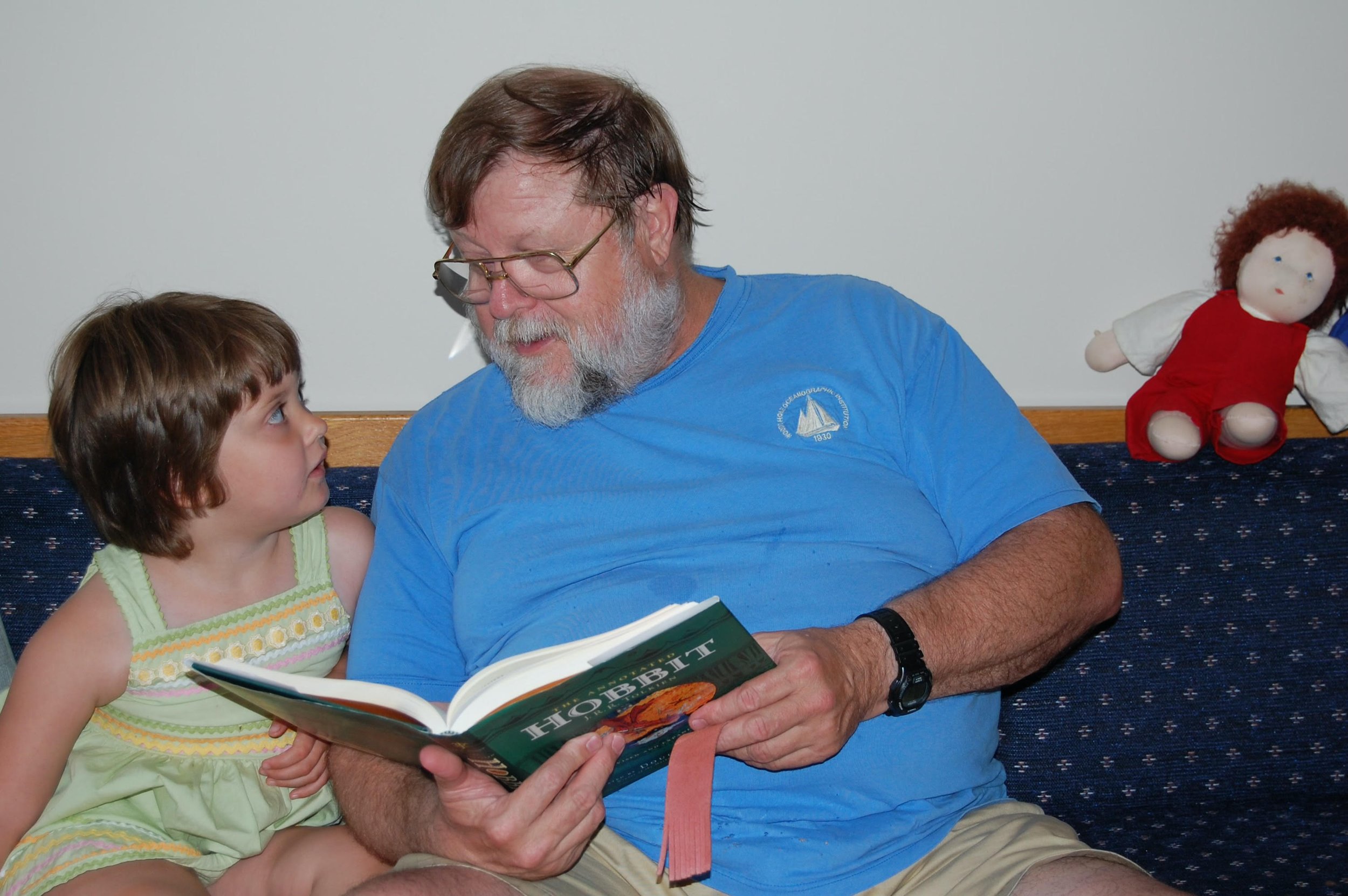
Tolkien was the brightest star in Geoff's galaxy of literature, but not his only interest. From his teens through his twenties, Geoff was a science fiction fan. In his thirties he enjoyed fly fishing and reading about fly fishing. Throughout his career as a self-taught electronics engineer, he devoted himself to reading about computer design, programming and low power communication. In his forties into into fifties, in addition to his independent reading, he read aloud to me almost everything Bill Bryson ever published from humorous travel accounts to The Body, A Guide for Occupants at 464 pages.
Starting in his fifties, Geoff dove into long books about history, especially historical biographies and true stories about developers of technologies. He was especially intrigued by Guglielmo Marconi who developed radio technology. Starting in the 1960s, Geoff honored Marconi with frequent pilgrimages to the Wellfleet site of the first wireless communication between Europe and the US. We returned to this ocean front site as a family to honor Geoff a week after his unexpected passing.
Geoff had patience for long, detailed history books that I considered too tedious for my taste, yet when he read the book John Adams by David McCullough to me as part of my preparation to teach US History, I was captivated. Geoff always read books and magazines about his interests: ham radio, very low power electronic transmission, astronomy, bicycling and, in his seventies, birds. ( A word about Geoff's interest in birds. As Geoff approached retirement I suggested he take up a hobby that was not technical. "Maybe woodwork, or learn a musical instrument, or ... birds," I said. I thought he’d think about this for a few days. But he paused for just a minute and said, "birds, I think I'll do birds." Before long he was telling me about the behavior of backyard birds and reading books about birds.)
As a writer, I appreciated that Geoff was always game to read and comment on anything I wrote. My longest project at over 80,000 words, Lucy's Way, a novel for upper middle grade students, went through many revisions. I loved that Geoff would say, "It's about time I read it again." At one point I experimented with dividing the long story into two books. He read both books to a grandchild who had already listened to the one-book version. What a treat it was to listen to them discuss my failed attempt to make this work as a two book story and their preference of the one-book format.
This chronicling of Geoff's history as a reader is actually a prelude to what I'm trying to get to. The theme of these annual essays is what I'm still learning from Geoff as I reflect on his life. We're about to look more deeply into Geoff's practice of reading aloud and this will get to what stands out for me as a quality I would like to emulate.
Maybe it was his own love for books that led Geoff to reading aloud to me, to his kids and to his grandkids. As an elementary school teacher, my reading aloud was a professional expectation. Yet, I always felt like an amateur compared to Geoff. He read aloud smoothly, patiently, steadily. Unlike me, he never tripped over a word or delivered a phrase in a way that did not flow in the sentence.
Some people stop reading aloud to kids who are old enough to read to themselves. As a teacher I always tell parents to continue to read aloud to their kids because most kids are interested in stories that are beyond their independent reading ability. Geoff seemed to know this, but this was not the only reason he read to kids. He often told me how much he simply enjoyed reading aloud.
I remember my own enjoyment as I listened to him reading The Mouse and the Motorcycle and Tales of a Fourth Grade Nothing to Ben. Our kids were born nine years apart, so most books would not appeal to both of them at the same time. Nevertheless, he did read, Space, by Michener, to both kids when they were around 5 and 14.
Many people today listen to podcasts while doing tedious tasks. Back in the 1980's, Geoff's patient reading of eleven novels by Lucy Maude Montgomery, the author of a series on novels that included Anne of Green Gables, was the podcast equivalent that Nora and I both needed to get through the weekly routine of slowly untangling her long hair.
Geoff's patience in reading to children continued as a grandfather. If a grandchild asked him to read the same long book for the sixth time, he opened the book with no complaints. If they became enamored by a poorly written series that repeated the same plot line in each book, he read on. He might comment to me privately that he hoped they would soon move on to other authors, but, with the kids, he was an obedient reader they could count on, no questions asked. How often do we ever find that unquestioning, patient support as a child or as an adult?
When we read aloud, the reader and the listener enter together word by word, sentence by sentence, into the mind of the writer. We listen to the reader, and we also listen closely to the writer. Reading aloud is slower than silent reading, so, when we read aloud to children we teach them the art of listening.
We lead them through the thought patterns built by people who have taken the time to choose words carefully. We show them the power and beauty of story-making as an art form. When we read children books of their own choosing, we start them on a path where they think about their interests, where they learn to curate their choices as a reader.
When I started writing this essay, I thought that what I should try to learn from Geoff is patience. Then I realized that he would laugh at me characterizing him as patient, for he had less than no patience when in traffic or a check out line. He was especially annoyed when the person ahead of him in him in a check out line waited to sort through all their pockets and purses for their credit card until after the groceries were all rung up. It wasn't taking more time that annoyed Geoff. It was that the person ahead of him in line was inconsiderate.
As I contemplated this, I realized that, in fact, what I want to learn from Geoff is deeper than patience. Maybe the word I was looking for is considerate. I raised this topic at lunch with grandchildren. What, I asked, was the quality Geoff (also known as Poppy) brought to to reading that was more than patience. Was it, I asked, the quality of being considerate?It was more that, they insisted. In many words and an outpouring of feeling they told me that, when he read to them, they could really feel how much he cared about them.
I started writing this essay thinking I would end up trying to learn patience from Geoff. But, in the end, patience isn't the lesson. Caring is the lesson.
###
No matter whether I was the only listener or was listening in the background as he read to children, Geoff's steady voice always made me feel the warmth of home.
I loved listening to Geoff read.